

A2L Refrigerant & Dissipation Control Integration with SmartZone Systems
When using A2L refrigerants (like R-454B), HVAC systems must include safety features to detect leaks and prevent refrigerant accumulation in occupied spaces. This is typically handled by an A2L dissipation or mitigation board, which monitors refrigerant sensors and triggers a response if a leak is detected.
In systems with zone control (such as Ecojay’s SmartZone-4X and 3X 3.0), integrating this safety feature becomes critical. If a leak is detected, the mitigation board sends a signal that must:
This integration ensures compliance with UL 60335-2-40 Ed. 4 requirements and helps protect occupants while maintaining zoning functionality.
In systems with zone control (such as Ecojay’s SmartZone-4X and 3X 3.0), integrating this safety feature becomes critical. If a leak is detected, the mitigation board sends a signal that must:
- Shut off the compressor
- Force the indoor blower fan on
- Open all zone dampers to allow air circulation through the entire duct system and prevent refrigerant from building up in unused zones
This integration ensures compliance with UL 60335-2-40 Ed. 4 requirements and helps protect occupants while maintaining zoning functionality.
SmartZone - A2L - Version 24E and up
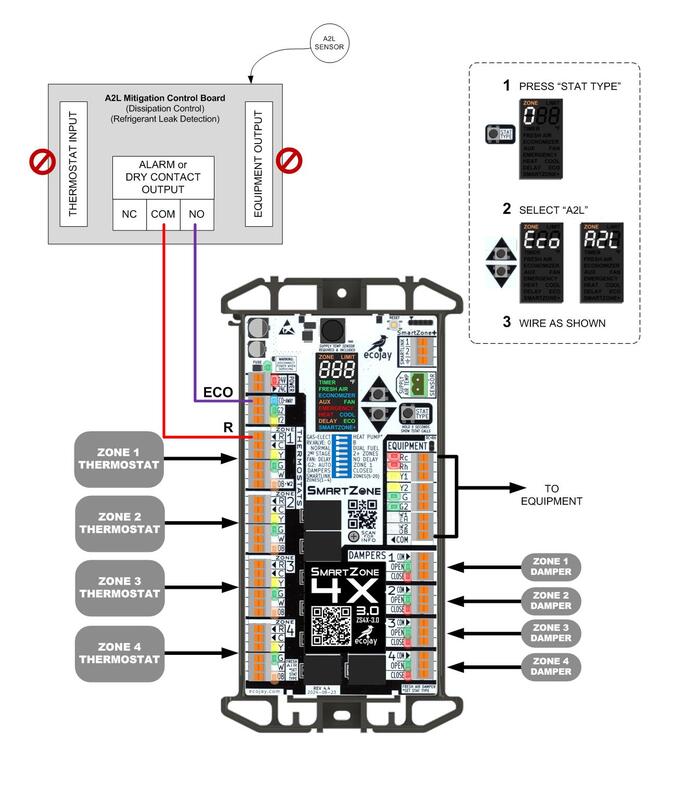 To enable this function on SmartZone-3X or 4X 3.0, press the STAT TYPE button and select “A2L” using the up and down arrows while “ZONE 0” is flashing on the display.
When A2L Mitigation Control Board detects a leak and sends a signal to SmartZone, ALL dampers will open and equipment output G and G2 will energize. Calls from thermostats will be ignored and dampers will remain open until the “A2L” signal is de-energized.
For compliance with the UL 60335 code for dampers opening during A2L dissipation.
For compliance with the UL 60335 code for dampers opening during A2L dissipation.
More about A2L
In the HVAC industry, an A2L sensor is a gas detection sensor specifically designed to detect A2L-class refrigerants, which are mildly flammable under ASHRAE Standard 34. These sensors are increasingly important due to the growing adoption of low-GWP (Global Warming Potential) refrigerants like R-32 and R-454B, which fall into the A2L category.
🔍 What is an A2L refrigerant?
An A2L sensor detects leaks of these mildly flammable refrigerants and is used to enhance safety in mechanical rooms, refrigerant piping chases, and occupied spaces.
⚡ How is it wired?
A2L sensors can vary by manufacturer, but typically they are hardwired and may support analog, digital, or relay output signals. Here's a general breakdown:
1. Power Supply
2. Signal Output (depends on sensor type)
Terminal Function
1. 24V Power (+)
2. 24V Ground (-)
3. Relay Common (C)
4. Relay Normally Open (NO)
5. Relay Normally Closed (NC)
6–7. Optional: Analog output or comm
📌 Installation Notes
🔍 What is an A2L refrigerant?
- A2L = Lower flammability (Class 2L)
- "A" = Low toxicity
- "2L" = Mildly flammable
- Common A2L refrigerants: R-32, R-454B, R-452B
- Used as environmentally friendlier alternatives to older high-GWP refrigerants like R-410A.
An A2L sensor detects leaks of these mildly flammable refrigerants and is used to enhance safety in mechanical rooms, refrigerant piping chases, and occupied spaces.
⚡ How is it wired?
A2L sensors can vary by manufacturer, but typically they are hardwired and may support analog, digital, or relay output signals. Here's a general breakdown:
1. Power Supply
- Usually 24V AC or DC
- Two terminals: Power (V+) and Ground (GND)
2. Signal Output (depends on sensor type)
- Analog: 4–20 mA or 0–10V output proportional to refrigerant concentration
- Relay Contacts: Dry contact output to trigger alarms, shutoff valves, or ventilation
- Digital Communication: Some may use Modbus RTU or BACnet MS/TP
Terminal Function
1. 24V Power (+)
2. 24V Ground (-)
3. Relay Common (C)
4. Relay Normally Open (NO)
5. Relay Normally Closed (NC)
6–7. Optional: Analog output or comm
📌 Installation Notes
- Typically installed near the floor (A2Ls are heavier than air)
- Should be located near potential leak sources (e.g., indoor coils, piping)
- Must be calibrated periodically
- Often required by code (e.g., UL 60335-2-40 Ed.4) when using A2L refrigerants in occupied spaces
- Systems with A2L refrigerants in occupied spaces may require a refrigerant detection system (RDS).
- Trigger threshold: RDS must activate well before reaching 25% of the Lower Flammability Limit (LFL).
- Compressor must shut off immediately to stop further refrigerant release.
- Indoor blower fan must activate to dilute leaked refrigerant and prevent dangerous concentrations.
- These functions are typically managed by a Mitigation Control Board (MCB) or A2L dissipation board.
- Systems using A2Ls must stay within specific refrigerant charge limits, based on room size and system type.
- If charge exceeds certain thresholds, leak detection and mitigation becomes mandatory.
- Indoor units must be installed with proper clearances and venting.
- Leak sensors are required when system components are in confined or enclosed spaces.
- After a leak is detected and mitigated, the system may require manual reset or technician intervention before restarting.
- Sensors must be calibrated, tested, and fail-safe (e.g., if the sensor fails, the system must behave safely).
- Systems must respond safely to a sensor fault or power failure—typically by shutting down refrigerant flow.
- Prevent accumulation of flammable refrigerant concentrations
- Ensure early detection and ventilation
- Comply with evolving refrigerant use in line with environmental regulations (e.g., AIM Act, CARB)
- American Standard units using R-454B are UL 60335-2-40 Ed. 4 compliant.
- These units come factory-equipped with an RDS and A2L dissipation board that automatically:
- Shuts off compressor
- Runs the blower fan
- Issues alarms if necessary
SmartZone 3.0 A2L Refrigerant Mitigation System Compatibility
SmartZone zone control systems include a shared A2L Refrigerant Mitigation Input designed to interface with HVAC equipment's refrigerant detection and mitigation systems.
When an A2L refrigerant leak is detected, the HVAC equipment's mitigation control sends the appropriate signal to the SmartZone controller. SmartZone responds by overriding normal zoning operation and opening all connected zone dampers, allowing the HVAC system's required mitigation airflow to be distributed throughout the building.
SmartZone's A2L mitigation input has been tested for compatibility with A2L mitigation and refrigerant detection systems from the following major HVAC manufacturers:
Trane / American Standard A2L System: Refrigerant Detection System / Mitigation Control Board (MCB)
Control Designation: SR2
Refrigerant Detection: A2L Refrigerant Sensor
SmartZone Compatibility: Tested
Integration: The Trane/American Standard mitigation system detects a refrigerant leak and initiates the equipment's required mitigation sequence. The mitigation signal is connected to the SmartZone A2L input, causing SmartZone to open all connected zone dampers.
CarrierA2L System: A2L Dissipation Control Board
Example Board: HK50ZA004 / HK50ZA007
SmartZone Compatibility: Tested
Integration: Carrier's A2L dissipation system provides a mitigation signal that can be interfaced with the zoning system. When connected to the SmartZone A2L input, SmartZone overrides normal zone operation and opens all connected dampers during a dissipation event.
LennoxA2L System: Refrigerant Detection System (RDS) / RDS Blower Control Board
Example Control: 508466-01
SmartZone Compatibility: Tested
Integration: Lennox's RDS detects an A2L refrigerant leak and initiates the equipment mitigation sequence. The mitigation signal is connected to the SmartZone A2L input, which forces all connected zone dampers open.
RheemA2L System: PlusOne® Refrigerant Detection System™
Control: Integrated Refrigerant Detection and Mitigation System
SmartZone Compatibility: Tested
Integration: Rheem's A2L refrigerant detection system initiates the required mitigation sequence when a refrigerant leak is detected. The mitigation signal can be interfaced with the SmartZone A2L input to open all connected zone dampers.
Goodman / Amana / DaikinA2L System: Integrated A2L Refrigerant Detection / Mitigation System
Example Accessory: Non-A2L Furnace Integration Kit 0230K00044
SmartZone Compatibility: Tested
Integration: Goodman, Amana and Daikin equipment may use integrated A2L detection and mitigation controls or an equipment-specific integration kit. The mitigation signal can be connected to the SmartZone A2L input. SmartZone then overrides normal zone operation and opens all connected dampers.
AAONA2L System: A2L Mitigation Controller
Part Number: ASM07563
SmartZone Compatibility: Tested
Integration: The AAON A2L Mitigation Controller monitors refrigerant detection sensors and provides control outputs for the mitigation sequence. The appropriate mitigation output can be interfaced with the SmartZone A2L input to force all connected zone dampers open.
YORK / Johnson ControlsA2L System: Refrigerant Detection System (RDS) / A2L Mitigation System
SmartZone Compatibility: Tested
Integration: YORK A2L documentation provides for mitigation control of zoning dampers, including external zoning dampers where applicable. The mitigation signal can be connected to the SmartZone A2L input, causing SmartZone to open all connected zone dampers.
Daikin AppliedA2L System: A2L Refrigerant Mitigation Control
Control: MT6210
Part Number: 910419225
Sensor: 910419801
SmartZone Compatibility: Tested
Integration: The MT6210 monitors A2L refrigerant sensors and provides mitigation control outputs. The appropriate mitigation signal can be connected to the SmartZone A2L input to force all connected zone dampers open.
Aspen ManufacturingA2L System: A2L Mitigation Control System
Control: A2L Mitigation Control Board
SmartZone Compatibility: Tested
Integration: Aspen's A2L mitigation system monitors the refrigerant detection sensor and initiates the required mitigation sequence. The mitigation signal can be connected to the SmartZone A2L input, causing all connected SmartZone dampers to open.
SmartZone A2L Mitigation Operation When the SmartZone A2L input receives the manufacturer's refrigerant mitigation signal:
- Normal zone operation is overridden.
- All connected zone dampers are commanded open.
- Equipment Fan (G) is energized + (G2) if applicable.
- SmartZone remains in the A2L mitigation state as required by the equipment's mitigation system.
- Normal zoning operation resumes when the mitigation signal is removed.
LEGACY SmartZone ZONING SYSTEMS & A2LSome zoning systems, however, do not have an A2L input (legacy systems including SmartZone 2.0). Some may need to be upgraded / replaced when installing new HVAC equipment but not all of them.
With SmartZone-4X 2.0, the “eco mode” input can be used but zone 1 will not be available, therefore rendering it a 3 zone board instead of 4.
With SmartZone-4X 2.0, the “eco mode” input can be used but zone 1 will not be available, therefore rendering it a 3 zone board instead of 4.


